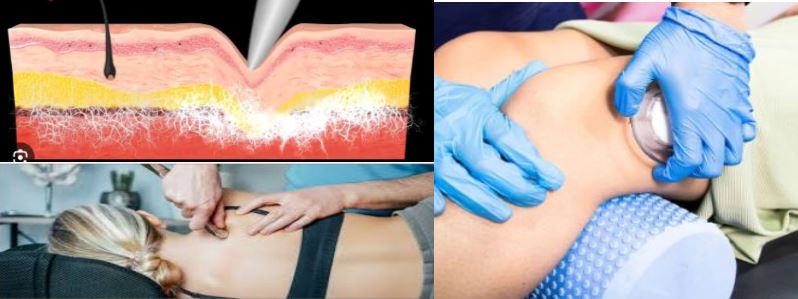
What is a “Soft Tissue Release” session?
A Soft-Tissue Release (STR) session is a 60-75 minute procedure where the doctor uses a variety of techniques to improve overall connective tissue health. This may include Instrument-Assisted Soft-Tissue Mobilization (IASTM), Active Release Technique (ART), Myofascial Decompression (MFD), problem-focused spinal manipulation therapy (SMT) and/or extremity adjustments, and other techniques as deemed necessary. By combining multiple techniques, a more optimal soft tissue response is usually achieved.
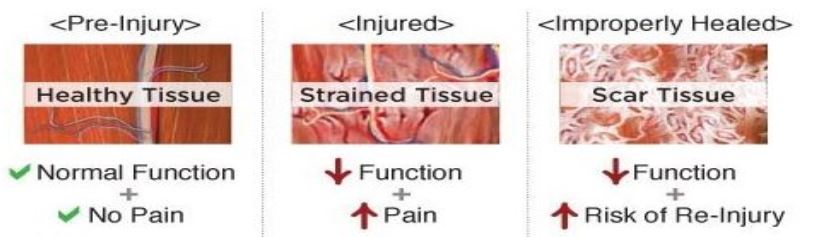
Benefits of Soft-Tissue Release:
Improves soft tissue dexterity, quality, and mobility * Allows for faster rehabilitation and recovery * Improves pain-free range-of-motion * Mobilizes muscles, tendons, fascia, and ligaments for more efficient healing* Resolves chronic conditions thought to be permanent * Helps patients return to everyday activities with less pain and better function * Treats scar tissue, fascial restrictions, soft tissue fibrosis, and chronic inflammation.
Common Issues Treated:
Neck & Back Sprain/Strains * Headaches / Migraines * Tendinitis / Tendinosis * Plantar Fasciitis * Rotator Cuff and Shoulder Problems * Carpal Tunnel Syndrome * Medial and Lateral Epicondylitis (elbow) * Patellofemoral Disorders/Knee problems * Piriformis Syndrome * Sciatica * Achilles Tendinitis/Ankle problems * Scar Tissue * Trigger-Points * Shin Splints * Hamstring issues * Pain * Other Soft-Tissue Abnormalities
$215 Per Regular Session / Per Area
(Partial coverage may be offered by some insurance plans – Please ask staff for details)
COMMONLY ASKED QUESTIONS:
1) HOW MANY SOFT-TISSUE RELEASE (STR) SESSIONS ARE RECOMMENDED?
Results will vary from individual to individual and are based on several factors (age, severity & duration of problem, integrity of the lesion, and general health status). 2-3 SESSIONS PER AREA ARE USUALLY ADVISED FOR BEST RESULTS, although most patients have a positive response after one treatment.
2) IS SOFT-TISSUE RELEASE (STR) PAINFUL?
The procedure can be uncomfortable, but most people tolerate it well, especially when a numbing agent is used. As such, we strongly recommend that you use a NUMBING CREAM that is to be applied 30 minutes before your session. Doing so will desensitize your tissues to some degree and allow you to be more comfortable during the procedure, while also allowing the doctor to work deeper for a better result. For your convenience, we carry a recommended numbing cream in-office.
3) IS TAPING RECOMMENDED AFTER SOFT-TISSUE RELEASE (STR)?
In some cases, yes. Most patients will exhibit bruising following an STR session. Taping allows for less bruising, less post-therapy pain, reduced swelling, improved muscle support, and in general, a faster recovery. Taping works by gently lifting the skin, which promotes better circulation through enhanced flow of blood and of lymphatic fluid . Once applied, the tape will last approximately 3-5 days on average. Taping is done 1-3 days following an STR session and must be scheduled in advanced. Taping is not recommended for everyone and is dependent on various factors. Your doctor will inform you if taping is recommended for your particular case.
4) ARE STR SESSIONS RECOMMENDED FOR PREVENTION & MAINTENANCE?
Absolutely! Fascial adhesions and other soft tissue problems are formed and can cause some level of dysfunction (such as tightness, stiffness, and discomfort) long before they manifest as actual pain, or even as a more substantial discomfort. STR sessions done on a periodic basis for prevention and for ongoing maintenance of joint, fascia, and overall connective tissue health is therefore strongly recommended to keep this from happening. Ask your doctor for appropriate frequency and recommendations for your particular case.
5) WHAT ELSE CAN BE DONE TO PREVENT SOFT-TISSUE PROBLEMS?
In order to maintain healthy soft tissues (so that you DON’T need many STR sessions), we recommend that you take our TRIGGER POINT & FASCIA THERAPY modules.
Here we teach you proven strategies to manage painful trigger points and to keep your fascia and connective tissues healthy and supple over time. These protocols are simple, but go a long way when performed consistently. We will teach proven and effective methods for this. Ask staff for a flier or for more information.
Once your fascia and other connective tissues are healthy, meaning that they glide well and do not cause stiffness or tension in your body, AND once trigger-point pain is minimal or non-existent, the next step to staying healthy, and arguably the most important step, is to engage in an ACTIVE mobility routine daily for a few minutes. For this, we recommend that you take one of our several MOBILITY classes. This type of training is different than traditional exercises performed for strength and endurance. Rather, it focuses on maintaining and promoting connective tissue health. For more information, feel free to inquire.
Additional Resources:
To learn more about fascia, what it is and its relationship to common musculoskeletal conditions, see resources below:
Fascia & The Mystery of Chronic Pain (Short)
Fascia & The Mystery of Chronic Pain (Full Video)
IASTM (used as part of our STR sessions)

FOLLOW US!